
The Internal Comms Roadmap for Distributed Workforces – 2026 edition




The 2026 internal comms roadmap for distributed workforces
TLDR: Internal communications often fail in distributed workforces because there is no clear plan. Messages become reactive, channels fragment, and more communication does not lead to better understanding. A simple internal comms roadmap brings structure and focus, helping organisations communicate consistently, reduce noise, and support people working across sites, shifts, and roles.
Internal communications has entered a new operational phase.
This roadmap reflects how internal communications is being operationalised inside large, distributed organisations in 2026 – moving away from reactive messaging towards structured, system-led delivery employee communications.
In summary
- Internal communications in 2026 is about systems, not volume
- Distributed workforces require audience-led, not channel-led communication
- Campaign thinking has replaced one-off announcements
- Internal brand alignment is now operationally critical
- Measurement must be practical, decision-focused, and repeatable
By 2026, most large organisations no longer operate from a single office, workforce type, or communication channel. Teams are distributed across sites, shifts, regions, and employment models. Frontline, operational, technical, corporate, and leadership audiences all require different information, in different formats, at different times.
The challenge is not intent or effort. It is execution at scale. And it doesn’t happen by itself … you need an intentional internal comms roadmap for distributed workforces.
This roadmap outlines what effective internal communications looks like in 2026 – and why leading organisations are moving away from reactive messaging towards systemised internal comms models.
1. From message volume to message discipline
Internal comms output has increased, but, you might have noticed … engagement has not. In fact, it’s struggling more than it ever has.
You see, in distributed environments, volume without structure creates “noise”. This leads to confusion, mistrust, and disengagement. Employees stop distinguishing between critical operational updates and low‑priority information.
By 2026, high‑performing internal comms teams focus on discipline:
- Fewer, higher‑impact campaigns rather than constant announcements
- Clear prioritisation aligned to operational risk, culture, and EVP goals
- Structured messaging cycles instead of ad‑hoc requests
- Central governance with predictable delivery rhythms
Message discipline is now a core internal communications capability.
2. One workforce, multiple audiences
The concept of a single “employee audience” is no longer viable.
Distributed organisations must communicate across:
- Frontline and deskless workers
- Operational and technical teams
- Corporate and professional staff
- Leadership and people managers
- Contractors and extended workforce groups
- Differing levels of literacy and aligned languages
In 2026, effective internal comms strategies:
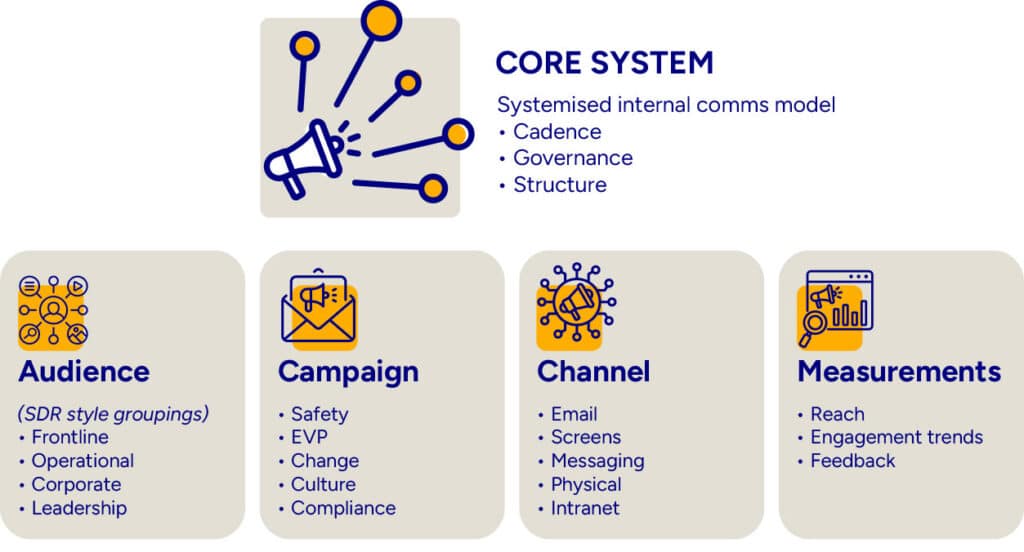
- Segment audiences clearly, often using SDR-style role groupings – Segmented Delivery Roles (SDR). This means grouping employees based on how they work, where they work, and the type of information they need – rather than treating the workforce as a single audience.
- Adapt language, depth, and format without changing intent
- Protect brand and EVP consistency across all variants
Systemised models are a key tool for any internal comms roadmap for distributed workforces. They make this segmentation scalable – without increasing the workload and facing a continual uphill battle to address multiple audiences.
3. Channels are tools – not strategies
Most organisations already suffer from channel sprawl.
Email, apps, digital screens, WhatsApp, intranets, posters, toolkits – these are delivery mechanisms, not strategies.
The 2026 internal comms roadmap for distributed workforces prioritises:
- Channel clarity – what each channel is for, and what it is not
- Consistent usage patterns so employees know where to look
- Content reuse across touchpoints to reinforce key messages
- Digital and physical channels working together, not competing
Successful teams optimise channels. They do not endlessly add new ones.
4. Campaigns replace announcements
Announcements are transactional. Campaigns are intentional.
In 2026, internal comms teams apply campaign thinking to:
- Safety and risk communication
- EVP and employer brand reinforcement
- Change and transformation programmes
- Policy, compliance, and behavioural shifts
A campaign approach includes:
- A defined objective
- Clear primary and secondary audiences
- Planned reinforcement over time
- Simple frontline engagement metrics
This shift significantly improves retention and behavioural uptake.
The important thing is to keep your campaigns consistent and relevant. Stuck? You might want to check out our managed internal communications subscription – CommsKit ENGAGE.
5. Internal brand is now business‑critical
Internal brand alignment is no longer a “nice to have”.
In distributed organisations, inconsistent internal communication directly impacts:
- Safety outcomes
- Culture and trust
- Leadership credibility
- External brand reputation
By 2026, internal comms roadmaps for distributed workforces include:
- Brand‑aligned internal templates
- Clear tone‑of‑voice guidance for operational contexts
- Visual consistency across sites and formats
- Central brand control with local operational flexibility
This is where systemised internal comms models outperform DIY approaches.
6. Measurement becomes practical, not performative
Most internal teams do not need complex dashboards. They need signals that inform decisions.
In 2026, effective internal comms measurement focuses on:
- Reach and visibility across workforce segments
- Engagement trends over time, not single‑send performance
- Qualitative feedback from frontline leaders and sites
- Campaign‑level learning linked to operational outcomes
Measurement supports improvement, not reporting theatre.
7. The rise of systemised internal communications models
The most significant shift is structural.
Organisations are moving away from:
- Ad‑hoc briefs and last‑minute requests
- Inconsistent design and fragmented messaging
- Over‑reliance on internal capacity
They are adopting systemised internal comms models that provide:
- A fixed monthly communication rhythm
- Pre‑defined campaign types
- Brand‑ready templates and toolkits
- Predictable governance and delivery
This mirrors the evolution of marketing from reactive execution to managed systems.
What is a systematised internal communications model? Read more here.
The 2026 internal comms roadmap for distributed workforces and beyond
The future of internal communications is not louder, faster, or more digital.
It is calmer, clearer, and more deliberate.
Organisations that succeed will treat internal communications as a system – not a service desk.
Glossary: common internal communications terms
SDR (Segmented Delivery Roles)
A method of grouping employees by role, environment, or risk profile to tailor communication delivery.
EVP (Employee Value Proposition)
The combined set of benefits, values, and experiences an organisation offers its employees.
Frontline engagement metrics
Practical indicators such as reach, recall, participation, and behavioural response within frontline or operational teams.
Systemised internal comms model
A structured approach to internal communications using repeatable campaigns, templates, and governance rather than ad‑hoc delivery.
Managing internal communications for large workforces is hard.
CommsKit™ makes it easier.
Disconnected people makes workplaces less safe and businesses less productive.
CommsKit has a managed solution that solves this challenge – consistently and on brand.

Discover ENGAGE →
A managed monthly communications programme – brand-aligned campaigns created, designed, and delivered on a fixed calendar. Your team approves. We do the rest.

CONNECT
Managed digital employee communications hub


ONBOARD
A consistent, repeatable onboarding system