
What is a systemised internal communications model?




What is a systemised internal communications model?
TLDR: Internal communications become ineffective when they rely on ad hoc messages and one-off campaigns. Without a system, teams stay reactive and consistency breaks down. A systemised approach brings structure, repeatability, and clarity, helping organisations communicate more reliably, reduce effort, and support large, complex workforces over time.
Internal communications has traditionally been reactive. A request comes in. A message gets written. A poster, email or WhatsApp goes out. Then the cycle repeats.
A systemised internal communications model takes a different approach. It replaces ad-hoc activity with a structured, repeatable framework that plans, produces and distributes internal communication in a consistent and measurable way.
For organisations with large or distributed workforces, this shift is critical. Without a system, internal comms becomes fragmented, inconsistent and heavily dependent on individuals. With a system, communication becomes predictable, aligned and scalable.
What does “systemised” actually mean?
A systemised internal communications model is built around four core principles:
Structure
Messages are planned in advance using a defined calendar. Communication is no longer reactive. It follows agreed themes, priorities and business rhythms.
Repeatability
Campaign formats, templates and delivery channels are standardised. This reduces effort, speeds up delivery and improves consistency.
Alignment
Messages are tied back to business objectives, values and behaviours. Safety, culture, performance and engagement are reinforced over time, not treated as one-off messages.
Measurement
Outputs and engagement can be tracked. What is sent, when, where and to whom is clear. Gaps and over-communication become visible.
This approach turns internal communications into an operating system, not a support function.
Why traditional internal comms models fall short
Most organisations still rely on informal internal comms processes. These typically include:
- Email-led communication with low engagement
- Last-minute requests driven by internal stakeholders
- Repeated explanations of the same messages
- Inconsistent tone and visual quality
- No long-term content planning
- Limited insight into what employees actually see or absorb
This model might work in small, office-based teams. It breaks down quickly in operational environments with frontline or deskless workers.
A systemised model is designed specifically to solve these challenges.
The core components of a systemised internal communications model
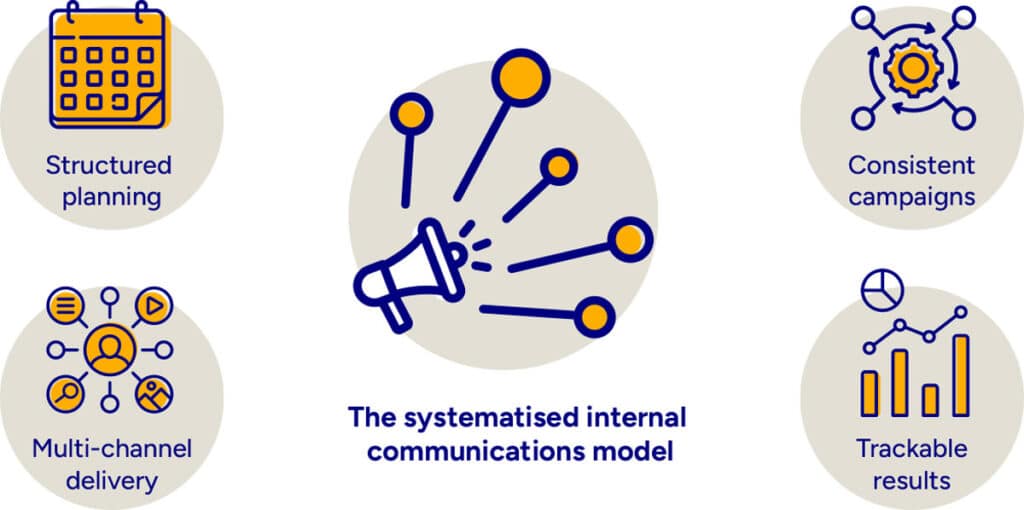
While every organisation will implement it slightly differently, a strong systemised model includes the following components.
1. A fixed communication calendar
A defined monthly or quarterly calendar sets the cadence for internal messaging. This includes:
- Core organisational themes
- Mandatory compliance or safety topics
- Cultural and values-based messaging
- Seasonal or operational priorities
This removes constant re-briefing and reduces internal noise.
2. Campaign-based messaging
Instead of isolated messages, communication is grouped into campaigns. Each campaign reinforces a single theme across multiple touchpoints.
For example:
- A main campaign message
- Supporting reminders
- Short reinforcement content
This approach increases recall and understanding, particularly for frontline teams.
You can see how this works in practice on the CommsKit Engage model.
3. Channel-appropriate delivery
A systemised model recognises that one channel does not suit all audiences.
Email, WhatsApp, digital screens, posters and toolkits each play a role. Messages are adapted for the channel, not copied and pasted.
This is particularly important for organisations supporting non-desk or operational teams.
4. Pre-built templates and frameworks
Templates remove friction. They also protect brand consistency.
In a systemised model, layouts, formats and tone are agreed upfront. This allows teams to focus on clarity and relevance rather than formatting and design.
This is a core principle behind the CommsKit platform.
5. Ownership and accountability
The system defines who owns the calendar, the content and the approvals. This reduces bottlenecks and avoids last-minute escalation.
It also protects internal comms teams from being treated as a reactive service desk.
Who benefits most from a systemised internal communications model?
This approach is particularly effective for organisations with:
- Large or distributed workforces
- Frontline or deskless employees
- High safety, compliance or operational risk
- Frequent change or transformation programmes
- Limited in-house internal comms capacity
Sectors such as mining, logistics, manufacturing, public services and healthcare see the strongest return from systemisation because communication failure has real operational consequences.
How systemisation improves engagement and trust
Employees disengage when messages feel random, repetitive or disconnected from reality.
A systemised internal communications model improves trust by:
- Creating consistency over time
- Reducing contradictory messaging
- Making leadership priorities visible
- Reinforcing key messages in simple, repeatable ways
Engagement improves not because messages are louder, but because they are clearer and more predictable.
Is a systemised model the same as automation?
No. Automation supports a system, but it does not replace it.
A systemised internal communications model is about decision-making, structure and alignment. Tools and platforms make execution easier, but they only work when the underlying system is sound.
CommsKit is designed to provide both – the framework and the execution support – without requiring large internal teams or complex tooling.
Learn more about how the CommsKit model works here
Final thoughts on systematised internal communications
Internal communication does not fail because teams lack effort. It fails because there is no system holding it together.
A systemised internal communications model gives organisations control, consistency and clarity. It turns internal comms from a reactive function into a strategic capability.
Managing internal communications for large workforces is hard.
CommsKit™ makes it easier.
Disconnected people makes workplaces less safe and businesses less productive.
CommsKit has a managed solution that solves this challenge – consistently and on brand.

Discover ENGAGE →
A managed monthly communications programme – brand-aligned campaigns created, designed, and delivered on a fixed calendar. Your team approves. We do the rest.

CONNECT
Managed digital employee communications hub


ONBOARD
A consistent, repeatable onboarding system