
Why most internal communications programmes fail – and what it’s actually costing you




Why Most Internal Communications Programmes Fail – And What It’s Actually Costing You
TL;DR: Most internal communications programmes fail not because of a lack of talent or tools, but because they lack a managed system. When comms are reactive, fragmented, and dependent on “heroic” individuals, they create a productivity tax that costs organisations millions. Moving from a series of ad-hoc tasks to a governed, calendar-driven architecture is the only way to eliminate communication noise and reclaim lost ROI.
The uncomfortable truth about why good intentions, talented people, and expensive platforms still don’t fix the problem.
Most organisations don’t set out to be bad at internal communications. They hire smart people, buy clever software and platforms, and really intend to keep employees informed. And yet, the numbers tell a story that should make any executive uncomfortable.
Gallup’s 2025 State of the Global Workplace report found that global employee engagement has dropped to just 21% – matching the lowest levels seen since the pandemic began. The historical cost of that disengagement is staggering, with estimates hovering around $8.9 trillion in lost productivity worldwide, equivalent to roughly 9% of global GDP.
Let’s stop and digest this a moment. 9% of the global GDP lost in productivity worldwide. Crazy, right?
Zooming in on the United States, the financial bleed from this disconnect is acute. Grammarly’s ongoing State of Business Communication research estimates the cost of poor workplace communication at up to $1.2 trillion annually across US businesses alone. At an individual level, that translates to a loss of between $10,000 and $55,000 per employee per year, depending on seniority.
This isn’t an isolated regional issue. In the UK, low engagement is similarly fuelling a £257 billion productivity gap. For a 1,000-person organisation, that’s potentially tens of millions lost annually – not to dramatic failure, but to quiet, compounding inefficiency.
The question isn’t whether internal communications matters. The question is why, despite knowing this, most organisations still can’t get it right. As we look at shifting internal comms trends in 2026, this pattern is becoming impossible to ignore.
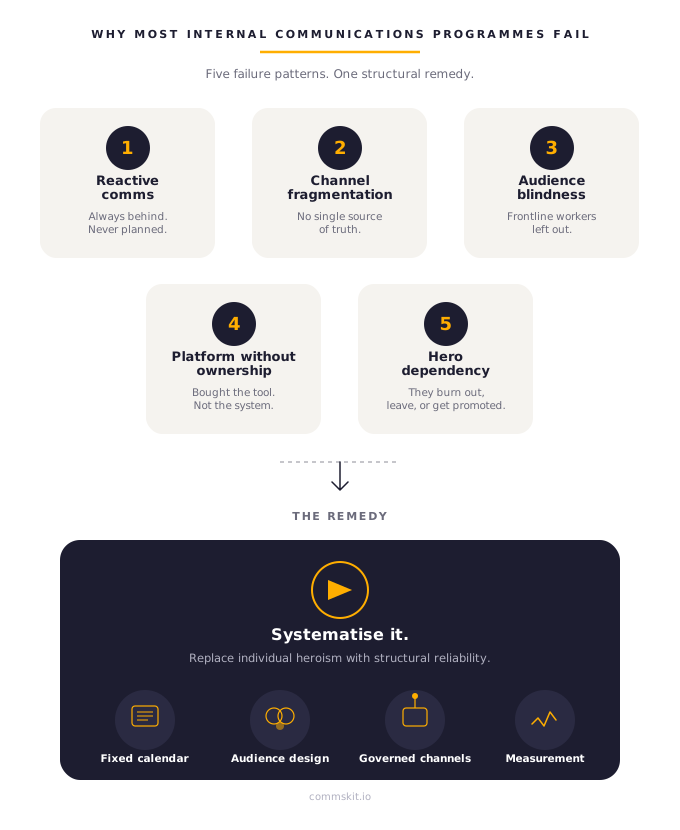
The 5 predictable reasons why internal communications fail
After more than a decade of working with large, complex organisations, we’ve identified a consistent set of failure modes that repeat themselves regardless of industry, geography, or budget. They don’t require a crisis to cause damage. They operate slowly, invisibly, and cumulatively – which is precisely what makes them so dangerous.
1. Reactive, not structured
In most organisations, internal communications operates as a response mechanism. Something happens – a policy changes, a safety incident occurs, leadership wants to announce something – and the comms team scrambles to produce and distribute a message.
The result: Employees experience a stream of disconnected “noise” that competes for attention rather than building understanding.
McKinsey Global Institute research suggests that productivity improves by 20–25% in organisations where employees are genuinely connected. But connection requires consistency, and consistency requires structure. You cannot achieve either in a permanently reactive environment. The alternative is a calendar-driven programme—the principle behind CommsKit ENGAGE.
2. Channel fragmentation without governance
Large organisations typically accumulate communication channels over time: email, intranets, digital signage, WhatsApp, and Teams. Each was introduced to solve a specific problem; none are governed as part of a coherent system.
The result: Frontline and deskless workers have no single, reliable source of truth.
Gallagher’s State of the Sector 2024/25 report found that half of communicators are dissatisfied with their channels’ ability to reach everyone. This is a governance problem masquerading as a technology problem. What’s needed is a managed hub like CommsKit CONNECT—not another channel to add to the pile, but the one that replaces it.
3. Audience blindness
Perhaps the most common failure is the assumption that one message fits everyone. An office-based worker checking email at a desk has a fundamentally different information environment than a plant operator on a 12-hour shift or a driver moving between sites.
The result: The people who need clear, reliable information most—particularly for internal health and safety campaigns—are the least likely to receive it.
4. Platform dependency without operational ownership
Buying an intranet or an employee app feels decisive. But a platform is not a programme. Without ongoing editorial governance and quality control, platforms degrade into digital dumping grounds—cluttered, stale, and eventually ignored.
The result: The platform was purchased; the operating model wasn’t.
5. Over-reliance on individuals
This failure mode should concern leadership most, because it feels like success—right up until it isn’t. In many organisations, internal comms works because of one or two exceptional people.
The result: Your communication strategy isn’t a business function; it’s a high-stakes personnel risk.
When these individuals burn out or leave, the institutional knowledge walks out with them. Any critical function that depends on the “heroics” of a specific person is a liability, not a strategy.
The cost of carrying on – this is why internal communications fail
Organisations that recognise these patterns but choose not to act aren’t standing still; they are accumulating cost. Gallup’s research shows that engaged employees perform 20% better and are 87% less likely to leave.
Conversely, SHRM estimates that the average large company loses $62.4 million per year to poor communication. Companies with effective communication strategies outperform their peers by 47% in total return to shareholders. That is not a marginal difference; it is a competitive chasm.
What actually works: Systematisation
The organisations that sustain effective internal communications treat it as a managed internal communications system, not an ad-hoc activity. Systematisation means:
- A fixed, calendar-driven programme rather than reactive messaging.
- Audience-specific design that accounts for frontline and operational staff.
- Governed channel architecture with clear ownership and standards.
- Consistent employee onboarding that doesn’t vary by site or manager.
- Content quality that doesn’t depend on one person’s availability.
The leadership decision
For C-suite leaders, this is ultimately a question of operational maturity. You would not run your finance function or your supply chain on improvisation. You would not accept a safety programme that depends on the personal heroism of one site manager.
And yet, many organisations accept exactly this from internal communications—a function that touches every employee, every day.
The choice is not between communicating and not communicating. The choice is between doing it deliberately—through a managed, governed system—and doing it accidentally, while absorbing the massive cost of inefficiency.
The data is clear. The patterns are predictable. The remedy is structural.
If your organisation is navigating these challenges and you’d like to explore what a managed internal communications system looks like in practice, book a short call to see whether CommsKit is the right fit.
Managing internal communications for large workforces is hard.
CommsKit™ makes it easier.
Disconnected people makes workplaces less safe and businesses less productive.
CommsKit has a managed solution that solves this challenge – consistently and on brand.

Discover ENGAGE →
A managed monthly communications programme – brand-aligned campaigns created, designed, and delivered on a fixed calendar. Your team approves. We do the rest.

CONNECT
Managed digital employee communications hub


ONBOARD
A consistent, repeatable onboarding system